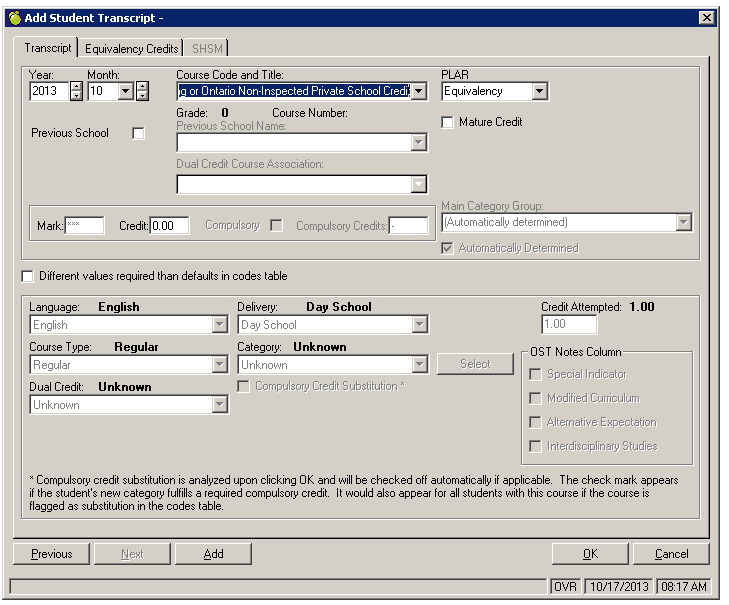
Enter the date (Year and Month) that the equivalency credit(s) was granted.
Select the equivalency course code or MDC from the Course Code and Title section
Regular day school students who are enrolled in Ontario secondary schools
- Challenge Process
- Equivalency Process
- Challenge Process
- Equivalency Process
How to Enter in Maplewood
Regular day school students who are enrolled in Ontario secondary schools
Prior Learning Assessment and Recognition (PLAR) is the formal evaluation and credit-granting process whereby students may obtain credits for prior learning. Prior learning includes the knowledge and skills that students have acquired, in both formal and informal ways, outside secondary school. Students may have their knowledge and skills evaluated against the expectations outlined in provincial curriculum policy documents in order to earn credits towards the secondary school diploma. The PLAR process involves two components: "challenge" and "equivalency".
The "challenge" process is the process whereby students' prior learning is assessed for the purpose of granting credit for a Grade 10, 11, or 12 course developed from a provincial curriculum policy document published in 1999 or later.
The "equivalency" process is the process of assessing credentials from other jurisdictions.
Challenge Process
Is an evaluation process and may not be used as a way for students to improve their mark in a course for which they have already earned a credit, nor as a way to obtain a credit for a course they have previously failed.
Students may challenge for credit only for Grade 10, 11, and 12 courses in provincial curriculum policy documents.
A maximum of four credits can be earned through the challenge process, including a maximum of two credits in any one discipline
Students cannot be granted credits through the challenge process for any of the following courses:
a course in any subject if a credit has already been granted for a course in that subject in a later grade either as a single credit or as part of a block equivalency
a course for which credit has already been granted or for which there is significant overlap with a course for which credit has been granted (e.g., a student cannot challenge for credit for an academic course if he or she has already earned a credit for the applied course at the same grade level, and vice versa)
a transfer course
a locally developed course
a cooperative education course
a course in English as a second language (ESL), English literacy development (ELD), or Anglais pour débutants (APD), if the student has one or more credits in English from the curriculum policy documents for English for Grades 9 to 12 under OSS (i.e., the documents for English-language schools or the documents for French-language schools) or from the curriculum guidelines for English or Anglais/English for Grades 9 to 12/OACs under OSIS
a course in French as a second language (FSL), Actualisation linguistique en français (ALF), or Perfectionnement du français (PDF), if the student has one or more credits in Français from the curriculum policy documents for Français for Grades 9 to 12 under OSS or the curriculum guideline for Français for Grades 9 to 12/OACs under OSIS
The following entries must be made on the student's OST:
For challenges for credit for Grade 10 courses: Only passing percentage grades will be entered on the OST. If the student subsequently takes the Grade 10 course, only the higher percentage grade will be recorded on the OST. No notation will be entered on the student's OST if the student withdraws from or receives a failing grade in the challenge process.
For challenges for credit for Grade 11 and 12 courses: Passing and failing percentage grades will be entered on the student's OST. No notation will be entered on the OST if the student withdraws from the challenge process
Assessment and Evaluation
Assessment and evaluation strategies for the challenge process must include formal tests (70 per cent of the final mark) and a variety of other assessment strategies appropriate for the particular course (30 per cent of the final mark). The formal tests must have a balance between written work and practical demonstration that is appropriate for the subject/discipline. Other assessment strategies may include evaluation of written assignments, demonstrations/performances, laboratory work, and quizzes, and observation of student work. The principal is responsible for developing and administering the formal tests and for determining which assessment strategies are most appropriate for each course for which a student is challenging for credit
Equivalency Process
Students who are eligible for equivalency credits are those who transfer to Ontario secondary schools from non-inspected private schools or schools outside Ontario. Equivalency credits are granted for placement only. The principal of the receiving school will, in the process of deciding where the student should be placed, determine as equitably as possible the total credit equivalency of the student's previous learning, and the number of compulsory and optional credits still to be earned.
Regular day school students who transfer to an Ontario secondary school from a school outside Ontario or from a non-inspected private school may be granted equivalent credits through the PLAR equivalency process for regular day school students based on the principal’s evaluation of their previous learning. The total number of equivalent credits and the corresponding number of compulsory credits are recorded on the OST. The equivalent credits should be entered as a total, and the required items of information should appear as follows: “Equivalent Credits” should be entered in the “Course Title” column; “PLE” in the “Course Code” column; “EQV” in the “Percentage Grade” column; the total number of credits in the “Credit” column; and the total number of compulsory credits in the “Compulsory” column.
For Grade 9 and 10 courses, record the total number of equivalent credits in this column. Up to 16 equivalent credits may be granted for Grade 9 and 10 courses. No more than 16 credits, earned and equivalent combined, may be granted for Grade 9 and 10 courses.
For Grade 11 and 12 courses, enter the appropriate value for individual credits granted or earned. Up to 10 credits may be granted through the PLAR equivalency and/or challenge processes. (Students may, of course, have earned some or all of these 10 credits through a secondary school program.) Students must earn 4 additional Grade 11 and 12 credits through an Ontario secondary school program.
Mature Students
Challenge Process
The "challenge" process for mature students is the process whereby students' prior learning is assessed for the purpose of granting credit for a Grade 11 or 12 course developed from an Ontario curriculum policy document published in 2000 or later.
Mature students may challenge for credit for up to 10 Grade 11 and 12 courses in provincial curriculum policy documents. However, they may obtain no more than 10 Grade 11 and 12 credits through the challenge and equivalency processes combined. There is no maximum on the number of credits that may be obtained in any one discipline.
Students cannot be granted credits through the challenge process for any of the following courses:
a course previously failed
a course for which the student has already earned a credit but for which he or she wishes to improve the mark
a course in any subject if a credit has already been granted for a course in that subject in a later grade either as a single credit or as part of a block equivalency
a course for which credit has already been granted or for which there is significant overlap with a course for which credit has been granted (e.g., a student cannot challenge for credit for an academic course if he or she has already earned a credit for the applied course at the same grade level, and vice versa)
a transfer course
a locally developed course
a cooperative education course
a course in English as a second language (ESL), English literacy development (ELD), or Anglais pour débutants (APD), if the student has one or more credits in English from the curriculum policy documents for English for Grades 9 to 12 under OSS (i.e., the documents for English-language schools or the documents for French-language schools) or from the curriculum guidelines for English or Anglais/English for Grades 9 to 12/OACs under OSIS
a course in French as a second language (FSL), Actualisation linguistique en français (ALF), or Perfectionnement du français (PDF), if the student has one or more credits in Français from the curriculum policy documents for Français for Grades 9 to 12 under OSS or the curriculum guideline for Français for Grades 9 to 12/OACs under OSIS
the Ontario Secondary School Literacy Course
Equivalency Process
There are two possible procedures for mature students. Previous learning may be assessed and credits granted either under OSIS (Procedure 1) or under OSS (Procedure 2), as outlined below.
Procedure 1
Principals will follow the process described in OSIS, section 6.14: Equivalent Standing for Mature Students, for granting equivalent credits to the following groups of mature students:
• mature students who were enrolled previously in the Ontario secondary school system, and were placed in Grade 9 before 1999–2000, Grade 10 before 2000–2001, Grade 11 before 2001–02, or Grade 12 before 2002–03; and who are working towards the OSSD under OSIS diploma requirements; OR mature students who were enrolled previously in the Ontario secondary school system and who are working towards the Secondary School Graduation Diploma (SSGD) under Circular H.S.1, 1979–81
• mature students who were new to the Ontario secondary school system, and were enrolled as mature students in the Ontario secondary school system before February 1, 2004; who were placed in Grade 9 in 1999–2000 or later, Grade 10 in 2000–2001 or later, Grade 11 in 2001–02 or later, or Grade 12 in 2002–03 or later; and who are working towards the OSSD under OSS diploma requirements Enter the appropriate code for each type of equivalent credit granted. (See OSIS, section 6.14, for a description of the first three types.)
The codes for equivalent credits are:
QEE Equivalent-education allowance
QAP Apprenticeship-training allowance
QMA Maturity allowance
QSE Credits granted for course work completed outside Ontario
Percentage Grade When “QEE”, “QAP”, “QMA”, or “QSE” has been recorded in the “Course Code” - Maplewood will automatically print the code “EQV” in the “Percentage Grade” column of the Ontario Student Transcript (OST)
Credit Enter the total number of equivalent credits in this column. The maximum number of equivalency credits that can be granted is 12.
Compulsory Enter the total number of compulsory equivalent credits in this column
Procedure 2
Principals will follow the Prior Learning Assessment and Recognition (PLAR) process for granting credits for prior learning to the following groups of mature students:
• mature students who are new to the Ontario secondary school system as of February 1, 2004, and who are working towards the Ontario Secondary School Diploma (OSSD) under OSS diploma requirements • mature students who were enrolled as regular day school students in the Ontario secondary school system, and were placed in Grade 9 in 1999–2000 or later, Grade 10 in 2000–2001 or later, Grade 11 in 2001–02 or later, or Grade 12 in 2002–03 or later; and who return to school as mature students on February 1, 2004, or later to work towards the OSSD under OSS diploma requirements Such credits may be granted through the equivalency process or the challenge process. (See section 6.6 of OSS and Policy/Program Memorandum No. 132.)
Enter the code “PLE” for Grade 9 and 10 equivalent credits. These credits must be recorded as one total.
Use the appropriate course codes for all of the following:
• courses successfully completed through an Ontario secondary school program
• equivalent credits granted for Grade 11 and 12 courses through the equivalency process
• credits granted for Grade 11 or 12 courses through the challenge process
• Grade 11 or 12 courses for which the student has repeated the challenge process
• Grade 11 or 12 courses that the student failed, and Grade 11 or 12 courses for which the student was unsuccessful in challenging for credit
Percentage Grade For equivalent credits granted through the equivalency process, Maplewood will automatically print the code “EQV” in the “Percentage Grade” column of the Ontario Student Transcript (OST)
Enter the percentage grade earned in all of the following:
• courses successfully completed through an Ontario secondary school program
• credits granted for Grade 11 or 12 courses through the challenge process
• Grade 11 or 12 courses for which the student has repeated the challenge process
• Grade 11 or 12 courses that the student failed, and Grade 11 or 12 courses for which the student was unsuccessful in challenging for credit
Credit For Grade 9 and 10 courses, record the total number of equivalent credits in this column. Up to 16 equivalent credits may be granted for Grade 9 and 10 courses. No more than 16 credits, earned and equivalent combined, may be granted for Grade 9 and 10 courses. For Grade 11 and 12 courses, enter the appropriate value for individual credits granted or earned. Up to 10 credits may be granted through the PLAR equivalency and/or challenge processes. (Students may, of course, have earned some or all of these 10 credits through a secondary school program.) Students must earn 4 additional Grade 11 and 12 credits through an Ontario secondary school program.
Special Note: There may be situations when a student will be granted PLE credits at different times. A student may be granted 6 PLE credits in September and then be granted 2 PLE credits in February. These entries should have different dates because the student may be assessed at different times. For example, the adult learning site helps the student prepare for the assessment and it takes time. They may be assessed for Science and then later English etc.. In this case 2 entries must appear on the Ontario Student Transcript (OST).
How to enter in Maplewood
Equivalency Credits:
Enter the date (Year and Month) that the equivalency credit(s) was granted.
Select the equivalency course code or MDC from the Course Code and Title section
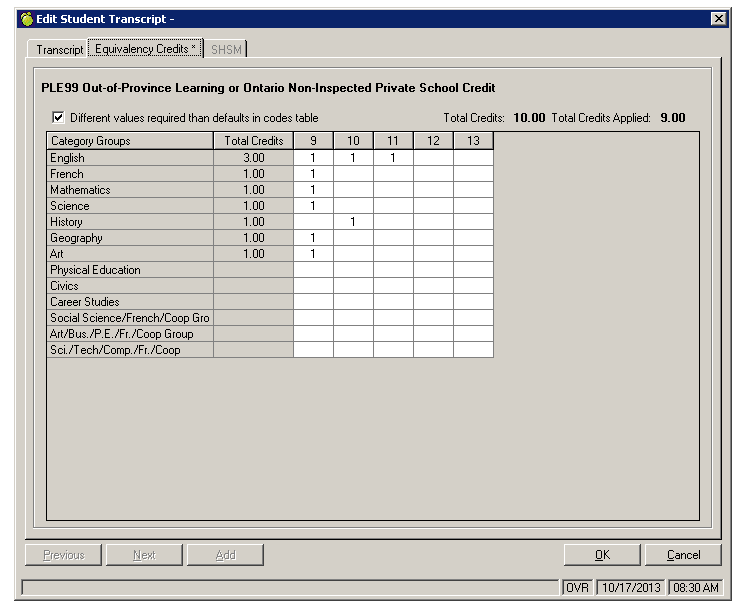
If a PLE course code is selected, the PLAR type is automatically set to 'Equivalency', and the Equivalency Credits tab becomes active. The Previous School information (if applicable), Mature Credit (if applicable) and Total Credits should be entered prior to selecting the Equivalency tab. On the Equivalency select the option 'Different values required than defaults in codes table'. This will activate the grid below and allow you to enter the number of credits for each grade and each requirement that the Equivalency Credit will be applied. Note: Some schools have a category group called 'Optional Credits' while others do not. For schools that do not have this category group, only enter the compulsory credits that are being granted with this credit. The remainder of credits (from the Total Credits entered on the first screen) will automatically count toward the optional credit component of the requirements.
Challenge Credits:
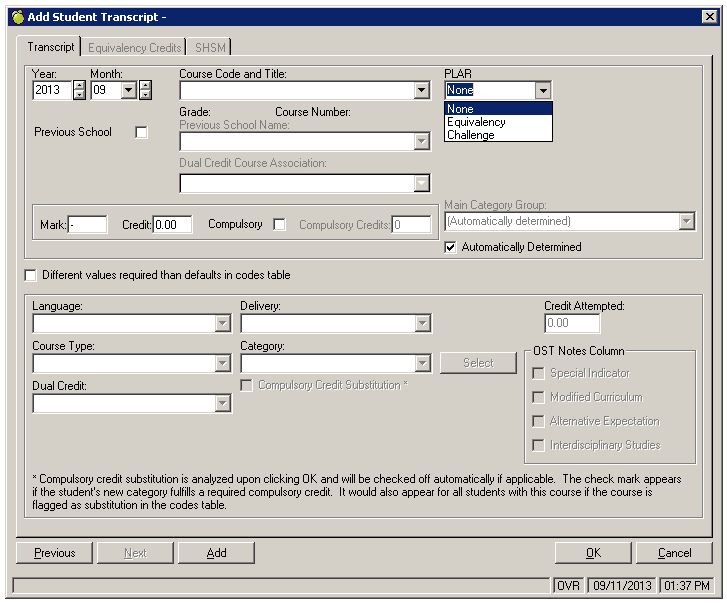
Enter the date (Year and Month) that the challenge credit was granted.
Select the Ministry Defined Course Code (MDC) from the Course Code and Title Section.
Using the PLAR pull down menu - select the Challenge option.
Enter the percentage grade the student received during the challenge process. All other values will populate with the default information that can be found within the code file for the school.
References and excerpts used to create this document include:
The Ontario Transcript (OST) Manual (Ontario Ministry of Education)
Policy/Program Memorandum No. 129 (Ontario Ministry of Education)
Policy/Program Memorandum No. 132 (Ontario Ministry of Education)