Prior to entering the master timetable into Maplewood, the number of semesters and terms must be correct in File, School Setup, School Information, This Year (for the current year) or Next Year (for the next year). In the spring of the current year, many schools begin the preparations for the new school year including the building of next year’s timetables. School Information setup screen is shown below and should match the school’s unique organization. Maplewood can assist in determining the correct setup for your school.
There are two types of periods: Basic and Pattern. Most schools are set for Patterns rather than Basic periods. The sections below explain the process to set them up.
Basic Periods
Basic Period can handle up to 2 semesters, 10 periods and 8 days. To set up Basic Pattern information, choose File, School Setup, School Information and click the This Year tab.
Number of Semesters: enter the number of semesters for the next school year to a maximum of 2.
Terms per Semester: enter the number of terms per semester to a maximum of 1.
Days per Cycle: enter the number of days per cycle to a maximum of 8. Cycle means the number of days that have different teaching patterns before returning to the first day of the teaching cycle. A maximum of 8 days is provided in the teaching cycle. If there is no differentiation of teaching days (i.e., the same classes are taught in the same order every day), enter "1’. If the cycle is based on the days of the week, enter 5".
Periods per Day: enter the number of periods per day to a maximum of 10. Periods means the number of periods taught in each school day. Later in the scheduling process, you can automatically schedule classes into these periods. Class can be scheduled automatically into single, double or triple periods depending on the information entered for the class. The length of each period should be uniform.
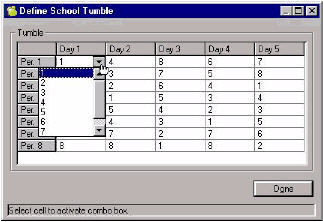
Tumble: Click the Tumble button to call up a Define School Tumble box. Often at schools, classes will follow a particular tumble. The tumble is the pattern followed in teaching the classes during the days in the cycle. For example, a school with 8 periods per day with a 5 day cycle may have the following tumble:
In this example, the lunch period (period 4) is always the fourth period taught in the day whereas the other classes can be taught in different periods depending on the day in the cycle.
Period Pattern can handle up to 16 semesters, 16 terms, 15 periods and 16 days. Occasionally, the school structure for the upcoming school year will differ from the structure currently in place. For example, there may be more periods in a day, or more days in the cycle too.
Pattern Schools
The Set for Pattern schools is simply the names given to groups of patterns. Each Pattern represents one possible teacher time frame in Semester, Term, Day, and Period. One pattern is set for the Semester(s) and Term(s), and other patterns are set for Day(s) and Period(s) which are applicable to the Semester/Term Pattern. Within the Windows version, the Patterns are completely user-defined. You can control the set and pattern names, and you have the flexibility to indicate where each pattern is taught.Within the Windows version, the Patterns are completely user-defined. You can control the set and pattern names, and you have the flexibility to indicate where each pattern is taught.
In this example, a school is set up as 2 semesters, and 2 terms per semester (as defined using File, School Setup, School Information, This Year Tab). Clicking the Patterns button allows you to make modifications or add new patterns. From this example, the Set name is called Single and one of its Patterns is called Sem 1. As you can see from the check marks, Sem 1 is scheduled for both terms in Semester 1. There is also a Pattern called Sem. 2 (which you would see if you clicked drop down arrow ) which has check marks in the Semester 2 column only.
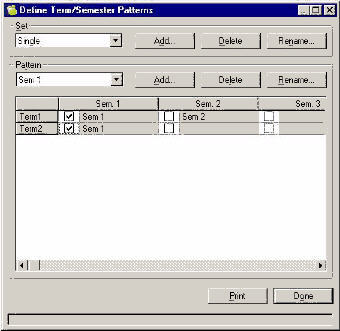
If the school offered classes that are to be taught over both semesters, you would have another Set called Full Year (or you might prefer to call it Both or Linear). One Pattern would exist called Sem 1&2 and it would have both Semester 1 and 2 columns checked.
If classes are taught in a single term, you may wish to create a Set called "Single Term" and create 4 Patterns called "Term1" (semester 1/term 1 checked), "Term 2" (semester 1/term 2 checked), "Term 3" (semester 2/term 1 checked), and "Term 4" (semester 2/term 2 checked).
To Create Semester/Term Pattern Names
After you have made your Pattern Set names, you must then define your Semester/Term information by creating patterns.
Note: If you do not select a Set first, Pattern Names will be placed from the first Set in the list.
To print a copy of the current Pattern Grid box, click Print.
Setting Up Day/Period Information
Now in the Windows system, the Period and Day fields have are combined and named to Period/Day. The Period/Day requires 2 pieces of information: a Set and a Pattern.
The Set is simply the name given to a group of patterns. Each Pattern represent one possible teaching time. For example, a Set called "Single" may have four Patterns called "Period 1", "Period 2", "Period 3", and "Period 4". Some schools may prefer to call them "Block A" through "Block D". Since the Pattern controls where the class is taught each day in the cycle, there is no need for the school’s Class Rotation.
Let’s assume a school has a 4 period day, 2 day cycle, where the classes are taught in reverse order on day 2 (e.g. rotation for day 1 is 1,2,3,4 and day 2 is 4,3,2,1). A Set is created called "Single" and a Pattern is created called "Period 1". Check marks are placed in the first period on day 1 and the last period on day 2. Once checked, the pattern name appears.
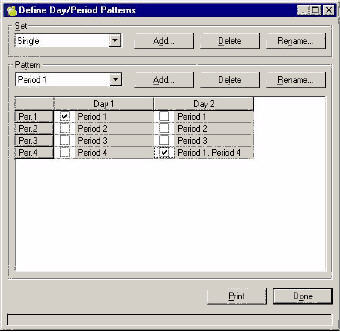
As the four patterns are created, the names appear so that you can tell where they are defined.
If you have classes that are taught on every other day, you might use a Set called "Alternate Day" and have 8 Patterns called "Per 1 Day 1", "Per 1 Day 2", "Per 2 Day 1", "Per 2 Day 2", etc.
Do you have to create all your patterns from scratch?
No! You will automatically have patterns for all the different class assignments you currently carry over in the initializing of school. The names will be similar to those explained above. You are free to rename these.
Day/Period Times Information
Scheduling Daily Period Times
You should specify the start and end times for each period for each day in the rotation for a term in a semester. The days that you specified will appear in tab format.